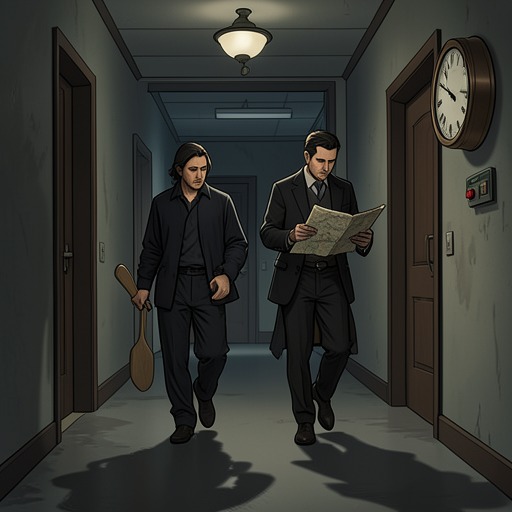
Statenville student-athlete deaths
Dead ShotThe Statenville student-athlete deaths are the central mystery that transforms a quiet southeastern Idaho town into the site of a concealed criminal and institutional disaster. Three local high-school football stars die within a short period, and residents are told that meth overdoses caused the deaths. The later investigation reveals a more disturbing reality: the victims died from a chemically altered marker placed in meth, while local officials suppressed the truth and federal agents struggled to contain the consequences of their own covert operation.
Causes and Background
The deaths emerge from a culture in which athletic ambition, drug use, and adult indifference have become tightly connected. Cody Murray, one of the dead athletes, knows steroids are dangerous and difficult to obtain in rural southern Idaho, but he regards the drug he uses as a harmless means of gaining extra energy during workouts. At first he takes it for performance, seeking a small boost rather than an illicit transformation; eventually, the boundary between athletic enhancement and recreational pleasure begins to disappear. His physical discipline and his dangerous consumption therefore belong to the same local ideal of relentless performance.
That ideal is reinforced by the surrounding sports culture. Mike Miller tells Cal Murphy and Kelly Mendoza that promising athletes commonly use drugs while few people in Statenville seem willing to care. Miller recalls warning Cody’s father, only to hear the father laugh and say that if the drug helped Cody get ahead, he supported it. Miller also explains that meth appears to offer athletes more energy and longer workouts, while college coaches may value how an athlete looks and performs more than how intelligently he uses his time. The deaths thus grow from more than individual recklessness: they are linked to a system that treats the athlete’s body as a route out of town and tolerates whatever seems to make that body stronger.
The immediate criminal background is broader still. The Federal Bureau of Investigation had deployed two agents to Statenville in deep cover to build a case against Deangelo and Cloverdale Industries, whose drug operation extended across a wide territory. The agents were supposed to insert a chemical marker into random batches of drugs so investigators could track the reach of the distribution network. The marker was designed to imitate the sudden onset of a rare disease, prompting attention from the Centers for Disease Control and Prevention and, eventually, the Federal Bureau of Investigation; it was not intended to kill anyone.
What Happens
Beginning on Sunday evening, the first of the three football stars is found dead in a gruesome scene, followed by the other two within the same general period. The deaths shock Statenville because the victims are not anonymous casualties but prominent young athletes associated with the town’s hopes and public image. The official explanation quickly reduces the tragedy to drug misuse: residents are told that all three student-athletes overdosed on meth.
Local law enforcement then turns that explanation into an administrative fact. Sheriff Jones tells Cal that the third victim is Devin Reid, Jim Reid’s son, while insisting that the young men died from simple drug overdoses rather than murders. When Cal points out that three deaths in a twenty-four-hour period appear suspicious, Jones retreats behind the demand for evidence. Jones says meth was found at all three scenes, but he also emphasizes that official toxicology reports will not be available for at least two weeks. The distinction between what is found at a scene and what actually caused a death becomes the first major fault line in the case.
The concealment becomes more explicit when Kevin Mendoza is pressured about his findings. Kevin initially indicates that the victims may have bled to death, but the caller rejects that conclusion and orders him to identify the deaths as drug overdoses, even though the toxicology screens have not yet established that result. The instruction does not merely anticipate a medical finding; it seeks to cancel the investigation before the evidence can speak. In this way, the deaths are converted from an open question into a predetermined public narrative.
The victims’ physical suffering is foreshadowed through Cody’s experience. While sitting in his recliner on a Sunday afternoon, he develops an itch above his elbow and digs his jagged fingernails into his arm to relieve it. The irritation first seems like a minor distraction from his sports magazine and his dream of appearing on its cover. In the larger pattern of the case, however, itching is the bodily sign of the lethal additive. What looks at first like a private consequence of drug use becomes evidence of an engineered mechanism of death.
The Revealed Mechanism
On Tuesday, an independent examination by Federal Bureau of Investigation officials determines that the student-athletes did not die from meth itself. They died from the marker with which the meth had been laced. A rogue FBI agent had altered the additive so that it would force liver bile rapidly into the bloodstream, producing uncontrollable itching beneath the skin. Already intoxicated by meth, the three victims scratched themselves to death.
This explanation radically changes the meaning of the scenes. Meth remains part of the circumstances, but it is not the decisive poison. The victims’ drug use made them vulnerable to the marker’s effects and helped the deaths resemble overdoses, while the visible scratching could be misread as a symptom of intoxication or a chaotic drug reaction. The body becomes both the site of the crime and the first record of its hidden method.
The intended marker program also complicates responsibility. The additive was created as a tracking device for a federal deep-cover operation, not as a weapon. Its lethal alteration is attributed to a rogue agent, meaning that the deaths arise from a covert effort designed to expose a criminal network but corrupted from within. The case therefore cannot be explained solely as a crime committed by Cloverdale Industries or as a failure of local policing. It is produced at the intersection of organized drug distribution, federal infiltration, and an unauthorized escalation of investigative technique.
One victim is identified as Riley Gold, Deangelo’s son. That connection gives the deaths an additional personal and strategic consequence. The death of a drug-using high-school athlete is publicly treated as a local overdose, but the death of Deangelo’s son places the family of the suspected criminal network directly inside the federal operation’s chain of consequences.
Cover-Up and Consequences
Despite the independent finding, Nathan Gold and local law-enforcement officials choose to dismiss the deaths as coincidence rather than attract unwanted attention to Statenville. The decision preserves the town’s reputation at the cost of the victims’ actual history. The public receives a simple story about reckless young men and meth; the concealed record includes a falsified medical account, a federal marker, a rogue agent, and a distribution network whose existence officials have reasons to hide.
The deaths also trigger the investigative movement that places Cal Murphy and Kelly Mendoza in danger. Cal refuses to accept that three young athletes could die of ordinary overdoses in one twenty-four-hour period, and the effort to suppress the case escalates into intimidation. His later arrest on trumped-up charges of possessing an open container and driving under the influence is presented as bullying intended to punish his pursuit of the truth. He recognizes that the secret behind the deaths threatens powerful people, not merely the reputation of a small town.
The pressure extends beyond the reporters. Guy Thompson has long accepted regular payments to treat Statenville as a sleepy, uneventful community, receiving a brown paper bag containing one hundred twenty-dollar bills each month in exchange for silence. The deaths expose the moral structure of that arrangement: the town’s apparent peace depends on people who decline to investigate what they suspect. Even when Guy realizes that Cal will not abandon the story, he fears that the pursuit of truth may cost Cal his life.
The danger becomes physical when Cal is shot in the arm during the continuing investigation, and when Cal and Kelly are treated as fugitives rather than witnesses or journalists. Law-enforcement officers are sent to Walker’s house under the pretext of investigating a disturbance, only to be told that Cal is there and that the reporters are to be arrested on further fabricated charges. The student-athlete deaths therefore move the narrative from suspicious local tragedy to armed repression, pursuit, and attempted control of evidence.
Wider Significance
The deaths expose the contrast between Statenville’s public image and its hidden structure. The town presents itself as peaceful, but its calm depends on official euphemism, coerced silence, falsified reports, and the willingness of powerful actors to treat dead teenagers as an inconvenience. The phrase “drug overdose” functions as both explanation and shield: it assigns blame to the victims’ habits while protecting the organizations and officials connected to the drug network and the investigation.
The case also dramatizes the pressure placed on young athletes to perform a narrow version of masculine success. Cody’s constant motion, desire for a scholarship, and dream of appearing on a sports-magazine cover make his body a public project. Adult approval turns chemical enhancement into a tolerated shortcut, while the culture surrounding him discourages caution by rewarding visible strength and endurance. His death reveals how a performance ideal can conceal vulnerability until the body itself becomes undeniable evidence.
By the end, the deaths are connected to the larger Cloverdale Industries investigation and to the collapse of the story Statenville has told about itself. Deangelo dies while trying to avoid charges after killing FBI agent Elliott Mercer, and the drug network is exposed as part of a far-reaching operation. Yet the student-athletes’ deaths remain distinct in their tragic irony: a marker intended to map criminal distribution instead becomes lethal, and the institutions best positioned to explain the tragedy participate in hiding it. The event’s decisive significance lies in that double exposure. It reveals both the reach of the drug operation and the corruption of the systems that claim to protect the town from it.